
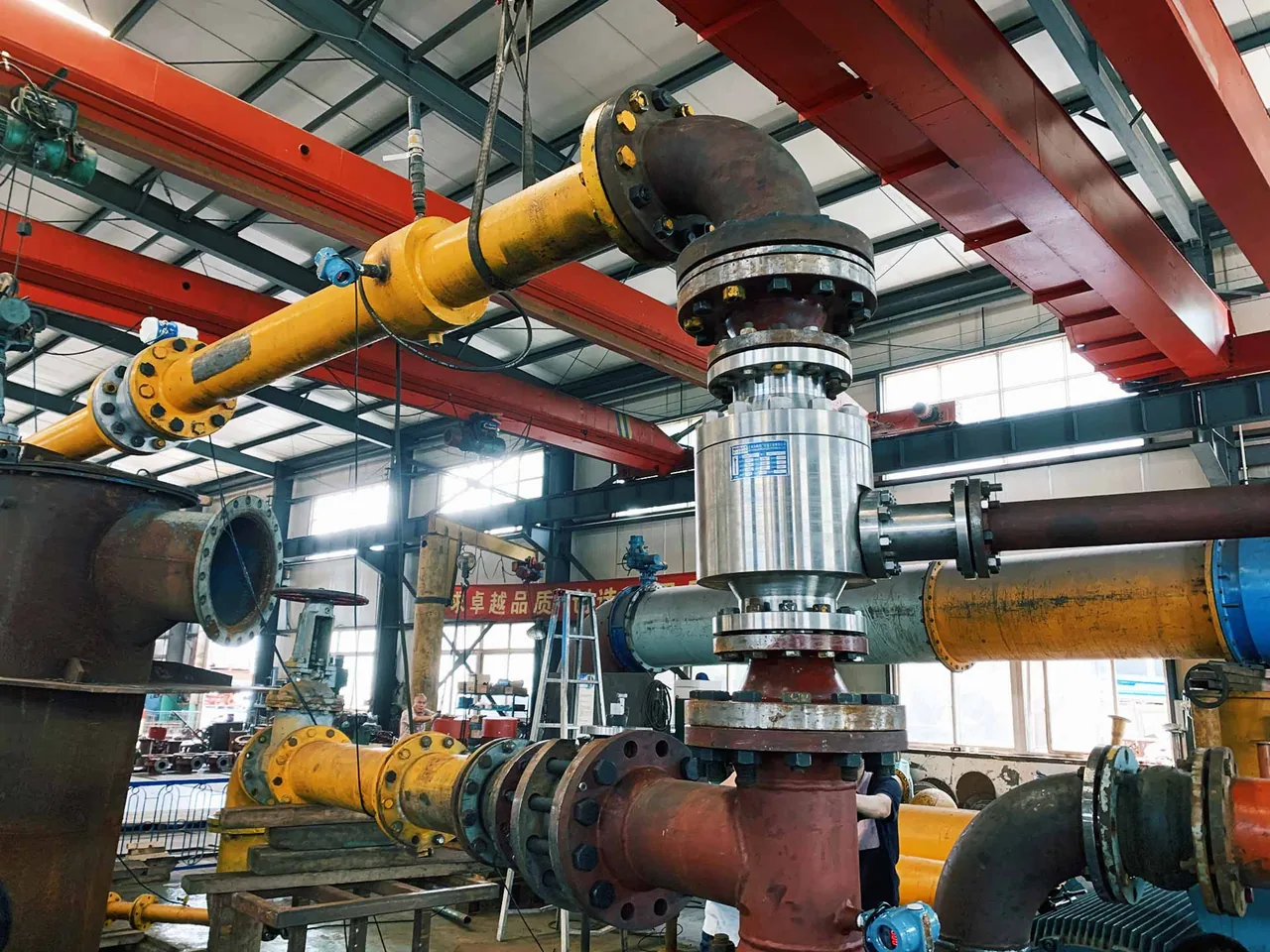
A centrifugal pump that runs below its minimum continuous flow does not fail gracefully — it overheats, cavitates, vibrates and wears out long before its time. An automatic recirculation valve (ARC valve) is the device that prevents that, automatically diverting just enough flow back to the suction or a recirculation line whenever forward demand drops too low. It does the job mechanically, in a single body, with no instrument air, controller or external signal — and for the pumps ACD's customers run, it is one of the most cost-effective pieces of protection on the system.
Why low flow damages a centrifugal pump
Every centrifugal pump has a minimum continuous flow below which it should not run for long. The energy the pump imparts to the liquid has to go somewhere; when forward flow falls too low, much of that energy turns into heat inside the casing instead of useful work. The liquid heats up, can approach its vapor pressure, and the pump begins to cavitate — vapor bubbles forming and collapsing against the impeller and casing.
The consequences stack up fast: temperature rise that can flash the liquid, suction-recirculation and discharge-recirculation that drive vibration, internal recirculation that erodes the impeller, and elevated radial and axial thrust that overloads bearings and seals. Run a pump against a nearly closed discharge or at deep turndown for any length of time and the damage is real — seized bearings, failed mechanical seals, cracked or eroded impellers. Protecting against low flow is not optional on a pump that has to be reliable.
What an ARC valve actually does
An automatic recirculation valve sits on the pump's discharge and senses the forward flow through it. When forward demand is high, the valve passes flow straight to the process and the recirculation path stays closed. As forward flow falls toward the pump's minimum continuous flow, the valve progressively opens a bypass that recirculates flow back to a tank, deaerator or the suction line — guaranteeing the pump always sees at least its safe minimum flow, regardless of what the downstream process is doing.
The defining feature is that it does this on its own. The valve responds to the flow passing through it mechanically; there is no flow transmitter, controller, control valve or instrument-air supply in the loop. The pump is protected even on a loss of power or air, which is exactly the kind of event during which a pump is most likely to be dead-headed. A non-return (check) function is built in as well, so the valve also stops reverse flow when the pump trips.
One body instead of a recirculation system
The traditional way to protect a pump's minimum flow is to assemble a small system: a check valve on the discharge, a tapped recirculation line, a restriction orifice or breakdown device to absorb the pressure, and a control valve — often with its own flow measurement and controller — to open the bypass when flow drops. It works, but it is several components, several leak paths and several things to specify, install, tune and maintain.
An ARC valve consolidates those functions into a single body. Depending on the model, it integrates the discharge check valve, the modulating minimum-flow bypass, and a pressure-breakdown stage that lets down the recirculated flow across multiple stages so the bypass itself does not cavitate. Fewer components means fewer potential failure points, a simpler installation, and one engineered device to maintain instead of a small assembly to keep in tune. For high-pressure boiler-feed service, multi-stage pressure breakdown in the recirculation path is what keeps the bypass from becoming a cavitation problem of its own.
Where ARC valves earn their place
Automatic recirculation valves are most at home wherever a centrifugal pump faces variable or low forward demand and cannot be allowed to run dry of flow. Boiler feedwater pumps are the classic case — they are high-energy, expensive to repair, and routinely throttled — which is why ARC valves are so common in power generation and on package boilers. Condensate, charge, reflux, pump-around, transfer and injection pumps across oil and gas, gas processing, petrochemical, chemical, mining and pulp and paper see the same duty and the same benefit.
ACD America is Datian's sales representative for the Americas, and supplies Datian automatic recirculation valves — the ZDT series and the wider ARC valve range — for exactly these services. They protect centrifugal pumps from low-flow recirculation damage with the single-body, self-acting design described above, backed by ACD's application-engineering support in the Americas. You can see the full ARC valve line, including model literature and datasheets, on the Datian brand page — or send us the pump and service conditions and our application engineers will help match the right valve to the duty.
Need the genuine part for this?
Send us the serial number, model or spec — genuine Fisher™ parts, fast quotes, shipped from our Orlando, FL warehouse.